
Gravitology and an Aging Population
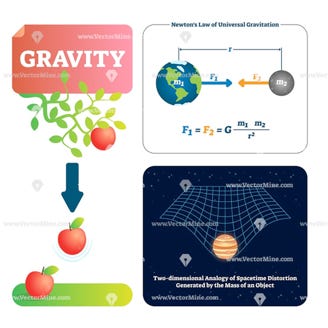
I have decided that as an emergency medicine physician, I have a sub-specialty. Henceforth I will refer to myself as a ‘gravitologist.’
My darling wife used to say, when she tripped, that she had experienced a ‘gravity storm.’
I feel as if every day in the ER we fight a running battle against gravity.
In fact, I see young patients complaining of falls more than ever. Perhaps an endless diet of streaming videos and sedentary existence causes young brains and bodies to just stop trying. An ankle sprain, a knee contusion, not even a fracture, and younger and younger people seem incapacitated. As one young woman said to me, after a fall onto her knee with a negative x-ray, ‘well if it’s not broken then how come it hurts, huh?’
I responded, not without sarcasm, ‘well, it’s bruised. You know?’ But I really don’t think she knew.
Sadly, we have so many sedentary young people, glued to phones, raised on screens, that it may well be that many of them just honestly never learned that bruises hurt. (It was a thing that we learned from an ancient technology called grandmothers back in the day. ‘Get back outside, it’s just a bruise. You’re fine. Have a cookie.’ Now THAT was medicine!)
The situation is much worse, however, because we have an aging population. And not only so, an aging population with many physical ailments. This is partly the result of the excellent medical care that allows them to survive and endure serious physical illnesses and injuries and live longer and longer lives. But I believe we have more falls in the aged because of the hard reality that as a nation, as a civilization, we’re just out of shape and weak.
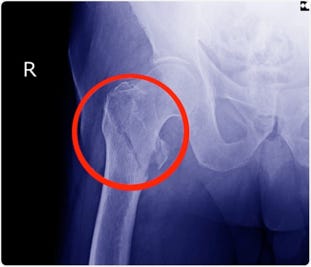
The ‘system’ isn’t prepared for this. Medicare, private insurers and hospitals struggle with the idea that a person who can’t walk can’t go home. Family members are also in a difficult situation. I frequently hear patients say ‘she needs to be admitted.’ And when I can’t find a good reason, as hard as I try, they say ‘well, we simply can’t take her home.’
They aren’t wrong. In particular, a person can’t go home if he can’t walk, or even pull up into a chair, and is very large. A 70Kg wife simply can’t manage an unstable 150 Kg husband when both are in their later years. Likewise, a skinny husband can’t handle an amply proportioned wife. It’s not judgement. It’s not ‘fat-shaming.’ It’s not policy.
At some point it’s simply physics.
All day and night we hear ambulances toned out for fall assistance. Ambulance calls for fall with injury. Seniors with falls from a standing position are sicker than ever with neck and head injuries, rib fractures and other significant trauma. Many of them are also taking medicine to lower their blood pressures, as well as sedating medications (for sleep, anxiety, depression or pain) and all of it with the icing on the cake being potent anticoagulants (blood thinners), all taken together quite literally prescriptions for disaster. (To be clear, a fall on a blood thinner can lead to all sorts of bleeding, but in particular bleeding in the brains.)
This was highlighted in a 2010 study which confirmed that over age seventy, mortality from low level falls goes up dramatically compared with younger patients. (The study is behind a pay-wall, so I also have a link is to an article about the research.)
https://www.urmc.rochester.edu/news/story/3020/for-elderly-even-short-falls-can-be-deadly.aspx
Health care as a whole must to come to terms with this. However, we can only add so many nursing homes, so many fall-prevention devices, so much home health care. Our ability to deal with diseases that come with age, such as heart disease, stroke and cancer, is remarkable and constantly improving. But humans are going to have to decide to stay fit, and get strong, in order to navigate the gravitational ravages of age.
We need to encourage everyone to see obesity as a deadly disease and incapacity as a thing to be avoided as long as possible, to be struggled against rather than embraced as the relaxing reward of a long life.
There are those who can’t help it; those simply unable to engage in any fitness-related activities; unable to get stronger for myriad reasons. But there are all too many who choose not to bother.
But a patient’s daughter said this to me, and it stuck.
“The recliner is the first coffin…”
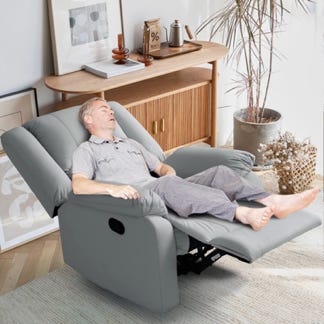
I’ve slept in recliners at work. I get it.
But I’ve also known folks who died, in no small part from endless inactivity.
Our ancestors knew that if you were too weak you would die. Modern man loves the idea of evolution in the abstract, failing to realize that part of evolution is being removed from the gene pool; a thing which gravity has done quite nicely since, well, forever.
It is indeed a blessing that we can delay death so handily with our incredible science. And yet, a curse. Because humans in modern societies simply rely on medications and hospitals and their workers to do do for them the things their bodies are already equipped to do, with only a little attention.
Gravity is a killer; but it doesn’t have to be a killer.
All human beings who can should walk, work, move, lift. Get a trainer. Work hard to get stronger. Limit calories. Stay mobile. All of which will allow them to live better. As physicians, we should encourage this with all the passion we urge vaccinations, seat-belts, gun safety and smoking cessation.
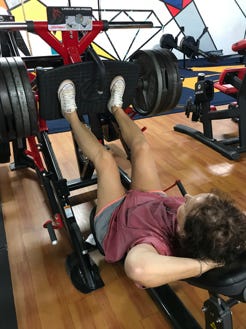
Without fitness, without strength, that gravitational acceleration of 9.8 m/s2 will land more and more people in the hospital; and finally in the ground. Where, of course, gravity will continue to pull, they just won’t notice.
I know what I’m talking about. I’m a gravitologist, after all.
Edwin
That recliner line is gold.
Fitness is the key. Corpulence is a curse. A GLP 1 can reduce obesity but it can’t make you fit. (Is that your spouse doing leg lifts?)